
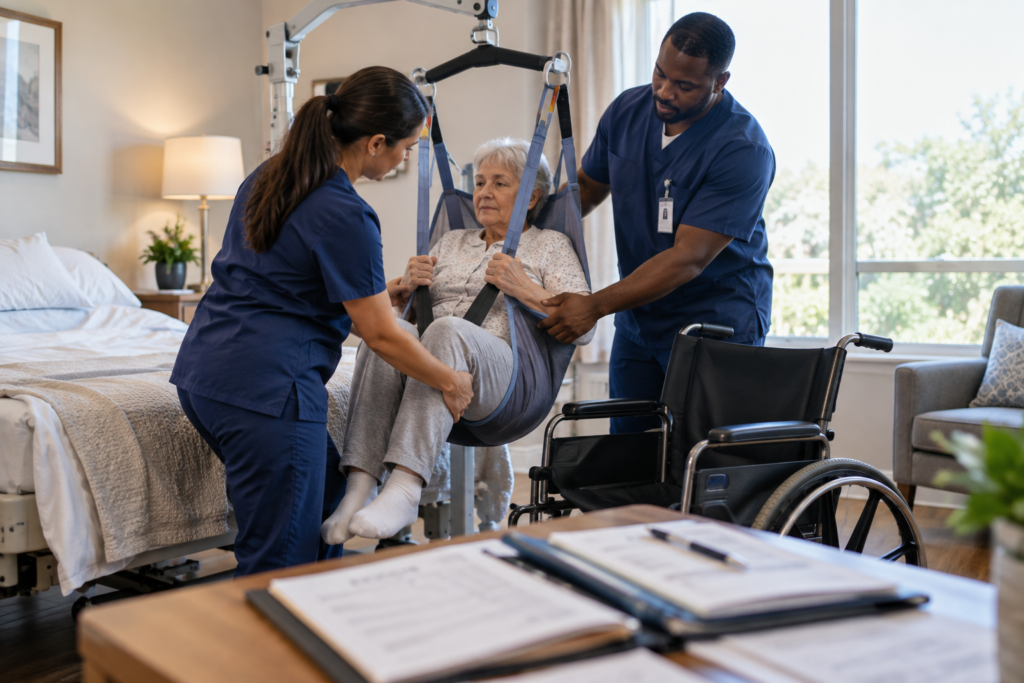
When a nursing home resident is hurt during a lift or transfer, families are often told it was simply an accident. Georgia and federal nursing-home rules say otherwise. Facilities must assess each resident’s needs and match the assistance provided to what that assessment calls for, so a transfer injury is worth comparing against what the facility had already determined the resident required.
When a Transfer Injury Raises Legal Questions
A bad outcome alone does not prove negligence. Federal rules require nursing facilities to complete a comprehensive assessment and build a care plan around it. Nursing care in Georgia must be provided according to that plan.
Federal survey guidance on accidents directs surveyors to ask whether a resident’s condition was assessed before a transfer and whether staff used the right equipment or number of caregivers.
What Care Plans and Staffing Records Can Reveal
A care plan may specify a Hoyer lift, a two-person assist, or a transfer belt, along with any fall-risk precautions noted after a prior fall or near miss. Georgia regulations also require facilities to provide mechanical lifters when a resident needs one and to maintain sufficient nursing staff to meet resident needs at all times. If a resident was assessed as needing that equipment but staff instead attempted a manual transfer, the mismatch can be telling.
Staffing schedules, training records, and CMS payroll-based staffing data can help show whether enough trained staff were present on a given shift, though this data generally cannot identify who handled a specific transfer.
In Andrews v. Blue Ridge NH Associates, staff were accused of dropping a resident during a mechanical-lift transfer. The appellate court focused on procedural questions, not whether negligence had occurred. Georgia courts have also distinguished ordinary negligence from professional negligence in transfer cases, a distinction that can affect whether a claim needs an expert affidavit.
Request the Records Before They Disappear
If a loved one was hurt during a transfer, the care plan, assessments, and staffing records from that period are worth reviewing promptly, before shift schedules and internal logs are archived or discarded. At The Williams Litigation Group, we can help request and review those records to see whether the transfer matched what the resident’s own care plan called for. Call us at 866-214-7036 or message us to discuss what happened.